FLORA
The flora and vegetation of the valley are abundant and varied. While Pyrenean oaks (*Quercus pyrenaica*) are found in the higher reaches, the hillsides are dominated by cork oak woodlands, thick with an intricate undergrowth of strawberry trees, heathers, rockroses, brooms, and Montpellier maples. Along the watercourses, a riparian forest thrives, featuring numerous Portuguese laurels (*Prunus lusitanica*)—a true remnant of the *Laurisilva* (laurel forest) that existed during the Tertiary period, when the climate was warm and humid. These Portuguese laurels grow alongside alders (*Alnus glutinosa*) and narrow-leaved ashes (*Fraxinus angustifolia*), with occasional holly (*Ilex aquifolium*), laurustinus (*Viburnum tinus*), and strawberry tree (*Arbutus unedo*)—all species that require high levels of moisture.
FAUNA
It is worth noting the visits of King Alfonso XI to this valley for the purpose of hunting, as well as his remarks in the book *La Montería* (1345), where he states that “the Vieja Valley is good bear-hunting terrain in winter… and near the *Texeda* [yew grove]—because the woodland is vast—the first time we hunted there, we encountered ten bears….” Naturally, neither bears nor yew trees remain in the area today, though both were once present.
Currently, the region abounds with mammals such as red deer, roe deer, wild boar, and mouflon (the latter having been introduced to the area), while otters can be found along the water’s edge. The birdlife along the riverbanks is a delight to both the eyes and the ears, featuring golden orioles, nightingales, white-throated dippers, and common kingfishers. Birds of prey are also frequently seen, including griffon vultures, Eurasian eagle-owls, peregrine falcons, and tawny owls—the latter’s hooting adding a touch of mystery to the mountain nights.
GEOLOGY
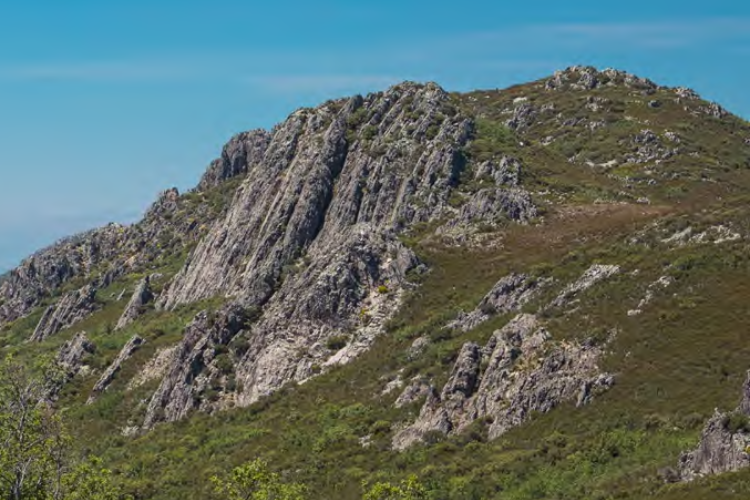
The Viejas-Torneros syncline stretches across the Geopark from the La Villuerca crag to Campillo de Deleitosa; the Viejas River flows through its southeastern section, while the Torneros stream runs through its northeastern part.
The geological materials found within this syncline consist of shales (slates) and quartzites dating from the Ordovician period. Between Robledollano and Castañar, there is a transverse fault at a site known as Canchos de las Narices. If you look closely—right by the roadside—you can see a “fault mirror”: a darker, shinier surface created by the friction between the shifting rock blocks.
These hillsides are rich in paleontological sites (fossils); the shales contain remains of trilobites, brachiopods, crinoids, and graptolites. On the quartzites, one can find deposits of pyrolusite (manganese dioxide)—crystalline aggregates that form dendritic (branch-like) patterns, which can sometimes be mistaken for fossils.