FLORA
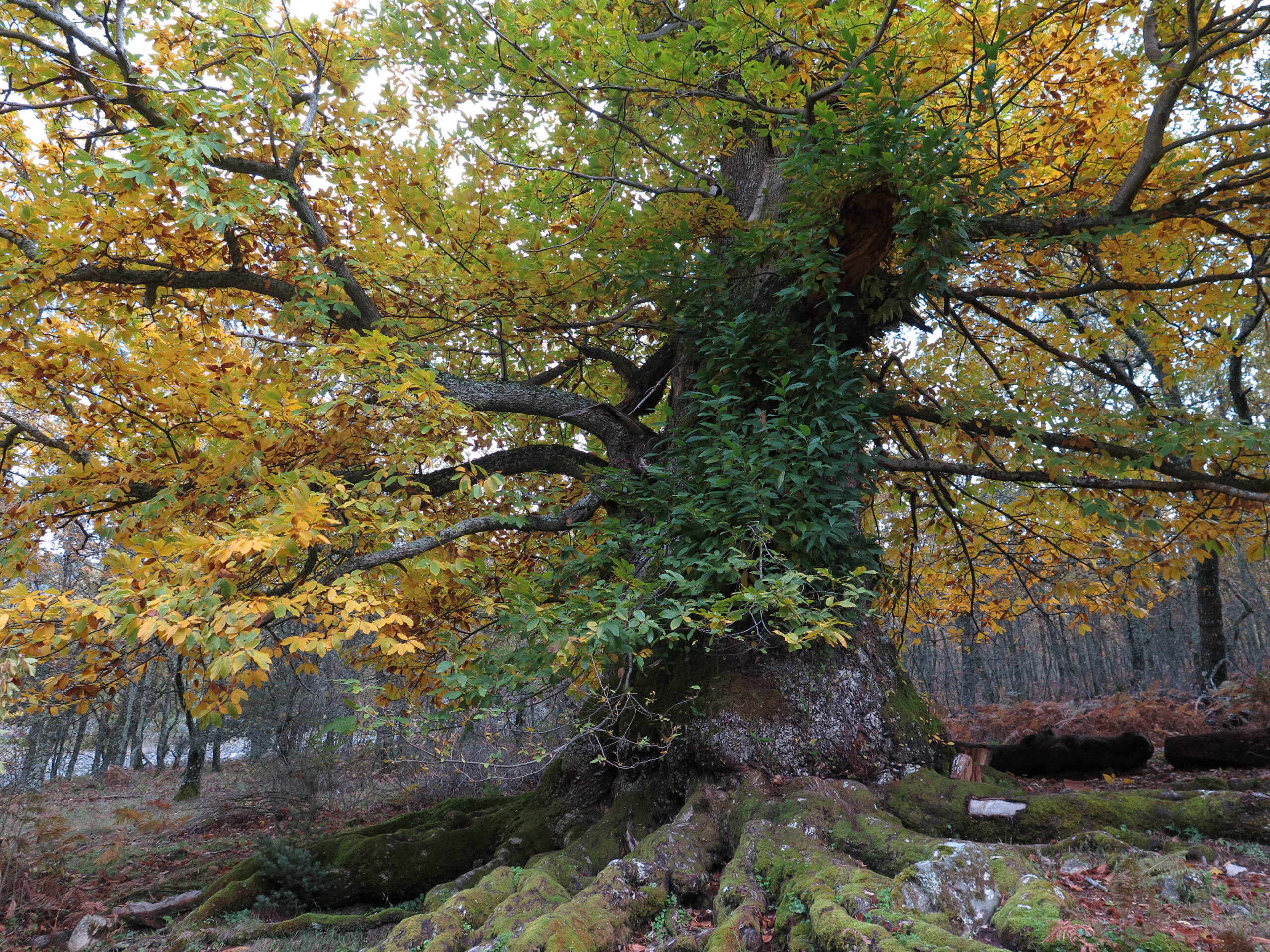
A beautiful forest of Pyrenean oaks (*Quercus pyrenaica*) grows on the quartzite slopes alongside the Calabazas Stream. This oak species is native to the area and represents its natural, undisturbed vegetation. Among these oaks, a group of fifteen ancient sweet chestnut trees (*Castanea sativa*) stands out along the Calabazas gorge. One particular specimen, known as the “Castaño del Postuero,” is notable for its remarkable, exposed root system—an adaptation to the instability of the rocky, scree-covered terrain—and a trunk height of 15 meters, though it was likely much taller before a lightning strike severed its crown. On the opposite side, amidst another stretch of scree, stands the magnificent “Quejigo de la Fuente” (a Portuguese oak, *Quercus faginea*), which reaches a height of 15 meters and has a trunk circumference of 3.30 meters. Both the group of chestnut trees and this Portuguese oak have been officially designated as “Singular Trees” (notable, protected specimens) of Extremadura.
Near the chestnut trees, one can find prickly junipers (*Juniperus oxycedrus*), while closer to the water grow several specimens of the Portuguese laurel (*Prunus lusitanica*). In the past—during a warmer, more humid climatic period—this tree was widespread throughout the Mediterranean basin; today, however, its population is restricted to a few isolated, damp enclaves.