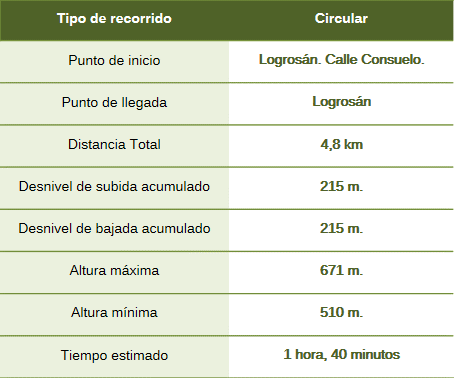
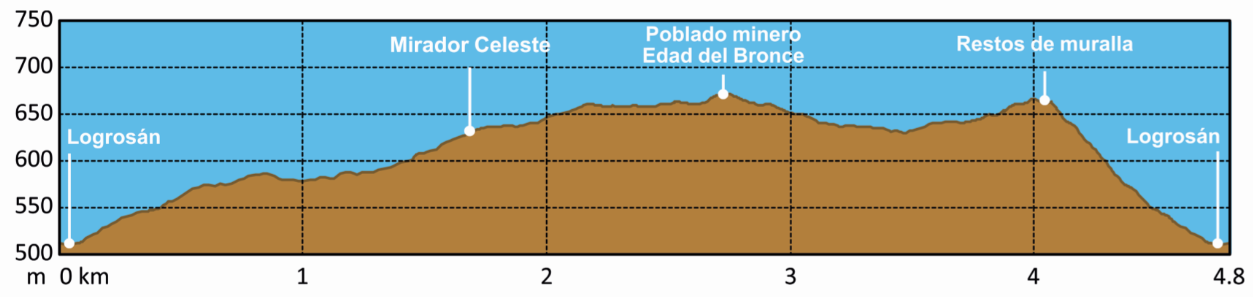
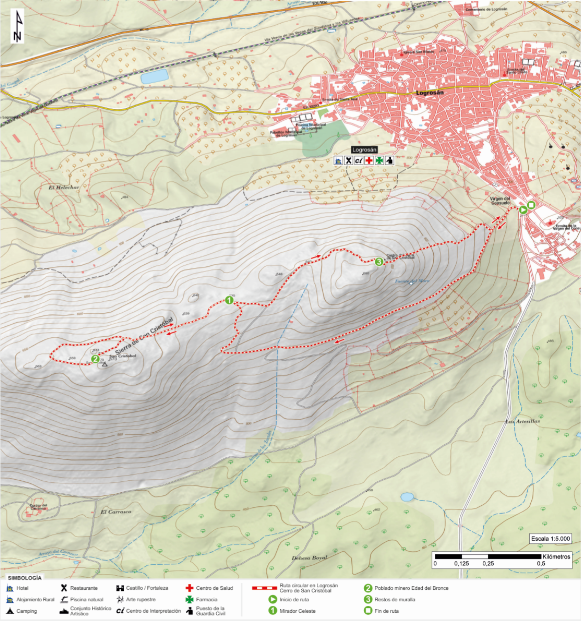
The route begins on Calle Consuelo, leaving the town via a path that ascends and skirts the southern slopes of Cerro de San Cristóbal—which reaches a maximum altitude of 680 meters—until it connects with a trail leading to the westernmost peak.

Before reaching this summit, we come across the Roso de Luna stargazing viewpoint on the right. These viewpoints serve as interpretive aids for the night sky, providing a schematic display of the major stars and constellations visible from that specific location. At the summit itself, there are remains of a mining site where excellent cassiterite crystals have been discovered. Trenches, galleries, and mining tools dating back to the late Bronze Age—linked to the Tartessian civilization—have also been found in this area. It is worth noting the granite rocks of this mountain range and their rugged relief, a result of the rock’s resistance to erosion compared to the surrounding shales in which they are embedded. The views from the hill are breathtaking; to the north, one can see the Las Paredes and Los Poyales ranges; to the east, the Sierra del Pimpollar, Risco Gordo, and Cañamero; and to the southeast, the *rañas* (alluvial plains) of Cañamero and Logrosán.
We leave this area and continue along the northern side of the hill to the eastern summit, where we find an ancient Celtiberian hillfort—a site later utilized by the Muslims due to the area’s mineral wealth. The descent to Logrosán follows the trail on the eastern slope, which has a gentle gradient and presents no difficulty.
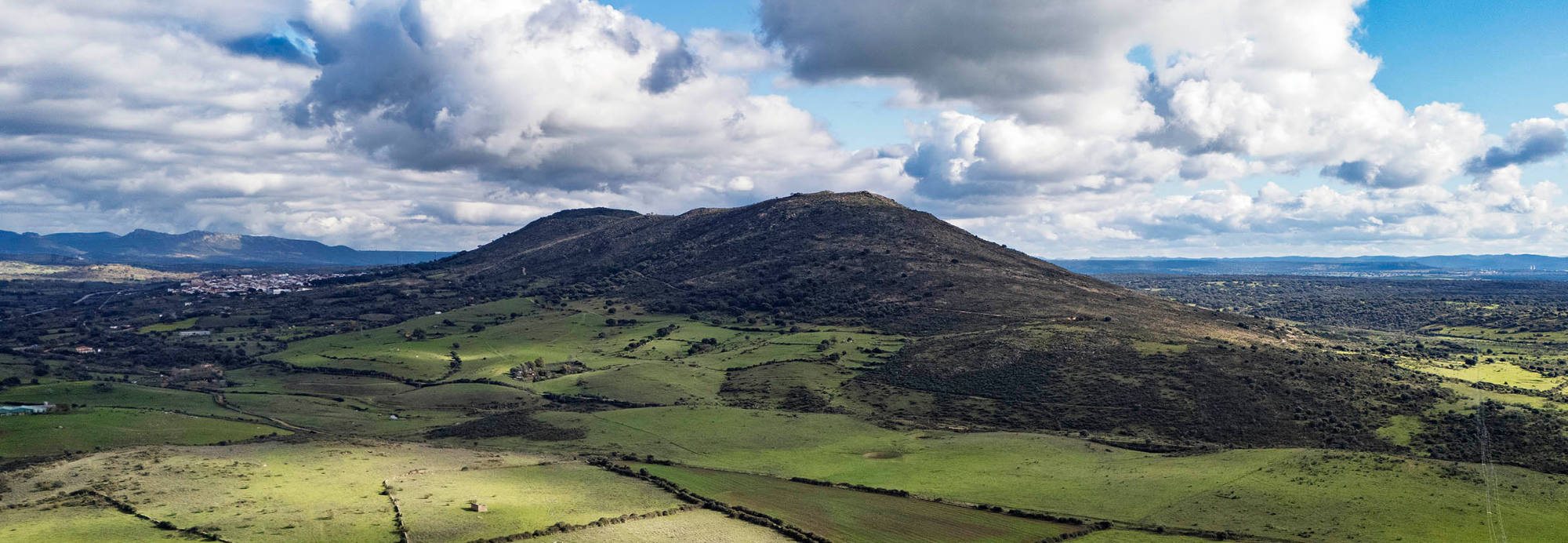
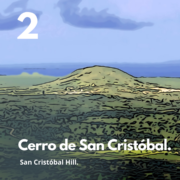
San Cristóbal Hill is an isolated granitic landform. It originated from the ascent of magma during the Carboniferous period (approximately 330 million years ago), which cooled slowly within the Earth’s crust. This process enabled the formation of minerals such as orthoclase, plagioclase, quartz, mica, tourmaline, and apatite. Over 300 million years of erosion, the surrounding, less resistant older rocks—belonging to the Domo-Extremeño Group (Ediacaran, around 600 million years old)—have been worn away, exposing this granitic massif. Veins of pegmatite, aplite, porphyry, and quartz containing cassiterite—formed by hot fluids released during the intrusion—are also commonly found here. It serves as a unique window into the deep structure of the Earth’s crust, allowing successive generations of inhabitants to exploit its mineral wealth.