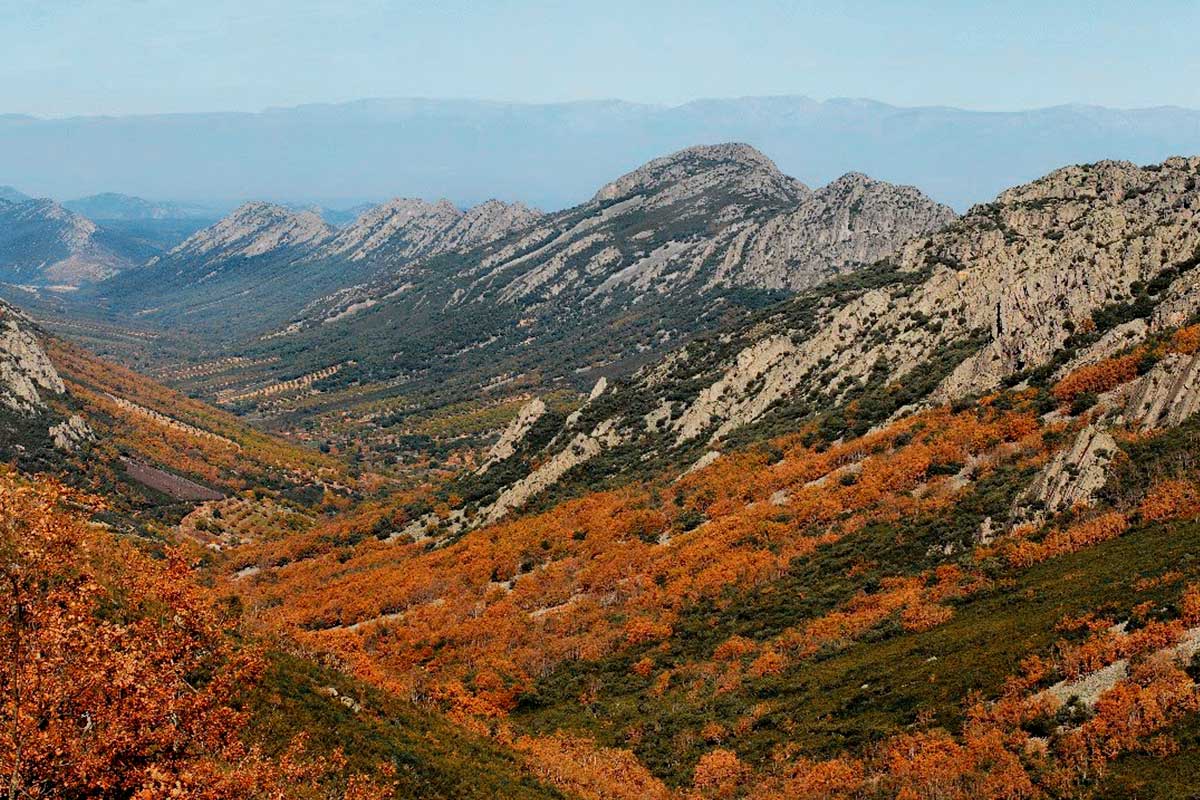
As can be seen in the diagrams drawn on geological sections, the materials visible along this syncline correspond mainly to quartzites and sandstones that make up the flanks, and a core mainly of shales deposited during the Lower and Middle Ordovician. On the slopes, we will find stony rocks where pyrolusite (MnO2) mineralization can be observed, with microscopic crystalline aggregates of colourful dendritic forms.
In the core of the syncline there are dark or greenish-brown shales due to alteration (Lutitas de Navatransierra) which, as in other areas of the Geopark, include important palaeontological deposits of marine arthropods (trilobites), brachiopods, bivalves, gastropods, cephalopods, crinoids, graptolites and bryozoans, although the greatest diversity is found in the trilobite group, with very typical genera such as Neseuretus and Illaenus.
To the south of the Collado del Pozo de la Nieve, the syncline has been dismantled, with a few remnant hills such as Pico Agudo and Las Amoladeras still remaining.
It is an area known for its Ordovician fossils, such as those mentioned above, which are typical of the continental platforms of the early Palaeozoic seas, together with the typical ichnofossils of the Armorican Quartzite, which in some places include spectacular deposits of Cruziana, as is the case in the vicinity of Pozo de la Nieve. Here can also be observed “sandstone mounds” (montículos de arenisca), an unusual sedimentary structures formed by currents that eroded the Ordovician sandy seafloor into prominent gullies and ridges.