FLORA
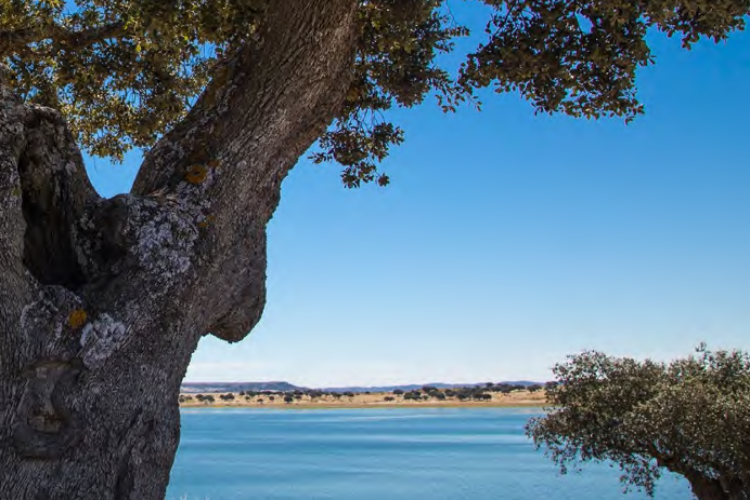
The *dehesas* (wooded pastures) surrounding the Ruecas and Cubilar river basins—which remain in a remarkably good state of conservation—feature an open canopy of evergreen *Quercus* species (holm oaks and cork oaks). Interspersed among these are areas of damp meadows, which are exceptionally rich in plant species such as rushes, sedges, and grasses. The orchid family is well represented by the genus *Serapias*, including species such as *Serapias cordigera* and, notably, *Serapias perez-chiscanoi*—a species discovered in Extremadura that is currently classified as “endangered.”
Another habitat well represented in this area consists of thermomediterranean scrublands known as *tamujares*, where the *tamuja* (*Flueggea tinctoria*)—a thorny shrub—grows along the banks of rivers that experience significant seasonal drying.
FAUNA
Among the fauna associated with the aquatic environment, the collared pratincole (*Glareola praticola*) and the little tern (*Sternula albifrons*) are particularly significant in the area; both are breeding species and are classified as sensitive to habitat alteration.
Also notable is the presence of steppe-dwelling birds, such as the large and magnificent great bustard (*Otis tarda*), the Montagu’s harrier (*Circus pygargus*), and the black-winged kite (*Elanus caeruleus*).
During the autumn season, one can find significant populations of common cranes (*Grus grus*), greylag geese (*Anser anser*), black-tailed godwits (*Limosa limosa*), northern pintails (*Anas acuta*), and many other waterfowl.
Fish species of note include the Guadiana nase (*Pseudochondrostoma willkommii*) and the Spanish spined loach (*Cobitis paludica*).