FLORA
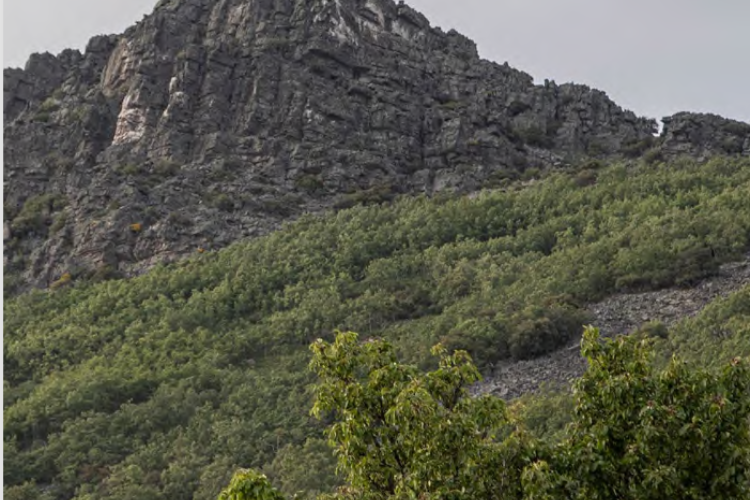
Both the sun-facing and shaded slopes surrounding these peaks support a forest of Pyrenean oak (*Quercus pyrenaica*), accompanied by the wild service tree (*Sorbus torminalis*). Notable floral elements found here include the Turk’s cap lily (*Lilium martagon*), the *Rhaponticum coniferum* (a species of knapweed relative), and the Toledo knapweed (*Centaurea toletana* subsp. *toletana*). The peaks are also home to a shrub known as *cenizo* (*Adenocarpus argyrophyllus*)—a legume with yellow flowers that is characteristic of the rocky summits within the Geopark.
In certain gorges of the Guadarranque-Gualija river system (such as those of La Trucha or El Mesto), one can find the finest examples of *loreras*—forests featuring laurel-like (lauroid) foliage. These woodlands have persisted here, whereas in many other parts of the Iberian Peninsula, they vanished following climatic shifts (the process of “mediterranization”). Additionally, in the Hospital del Obispo valley, there remain peat bogs or marshy wetlands—habitats more typical of a cool Atlantic climate than a warm Mediterranean one—which harbor an abundance of *Sphagnum* mosses, insectivorous plants, and intriguing orchids.
FAUNA
The woodlands provide shelter for the elusive roe deer (*Capreolus capreolus*), whose mating season—known as the “rut”—takes place in May. In September, the echoes of the red deer (*Cervus elaphus*) rut resound throughout these mountain ranges, a time when autumn hunts for red deer and wild boar (*Sus scropha*) are common.
The birdlife is rich in both cliff-dwelling and forest-inhabiting species. Among those that use the quartzite rock faces for nesting are red-billed choughs, blue rock thrushes, griffon vultures, Egyptian vultures, peregrine falcons, Eurasian eagle-owls, and a few pairs of large raptors, such as Bonelli’s eagles and golden eagles. In the forests, one can find tawny owls, lesser spotted woodpeckers, Eurasian jays, Eurasian sparrowhawks, short-toed treecreepers, Eurasian nuthatches, and various species of tits.
GEOLOGÍA
All these mountain heights form part of the southwestern flank of the Guadarranque-Gualija syncline (as well as the northeastern side of the now-vanished Ibor anticline, of which the *camorros*—prominent rocky outcrops—at Navalvillar and Castañar remain as evidence). From these vantage points, one can enjoy the best views of this syncline, the largest of those found within the Appalachian-style relief of the Geopark. The hard Armorican quartzites that make up these summits are rich in fossils—most notably in the Risco Carbonero area, where it is easy to find trace fossils such as *Daedalus*, *Skolithos*, and, to a lesser extent, *Cruziana*.