FAUNA
The Estrecho de la Peña serves as an excellent vantage point for birdwatching—particularly for species that nest among the crags, where the inaccessibility of these quartzite cliffs provides them with safety.
Notable birds of prey include the abundant Griffon Vulture (*Gyps fulvus*), the elusive Spanish Imperial Eagle (*Aquila adalberti*) and Bonelli’s Eagle (*Aquila fasciata*), the graceful Egyptian Vulture (*Neophron percnopterus*), and various falcons, such as the Peregrine Falcon (*Falco peregrinus*) and the Common Kestrel (*Falco tinnunculus*). At dusk, one may hear the hooting of the Eurasian Eagle-Owl (*Bubo bubo*). Other species that can be spotted around these impressive rock formations include the Eurasian Crag Martin (*Ptyonoprogne rupestris*), the White-rumped Swift (*Apus caffer*), the Red-billed Chough (*Pyrrhocorax pyrrhocorax*), and the Black Stork (*Ciconia nigra*).
Birds from the nearby forests may also be seen as they move through the area, such as the Eurasian Jay (*Garrulus glandarius*), the Eurasian Sparrowhawk (*Accipiter nisus*), or the Northern Goshawk (*Accipiter gentilis*). Along the course of the Jarigüela stream, one can observe species such as the Common Kingfisher (*Alcedo atthis*) and the White-throated Dipper (*Cinclus cinclus*).
FLORA
The local vegetation alternates between riparian forests near the water—filled with alders, ashes, and ferns—and the Mediterranean scrub and woodland typical of these mountain slopes, where rockroses, strawberry trees, holm oaks, and cork oaks thrive.
GEOLOGY
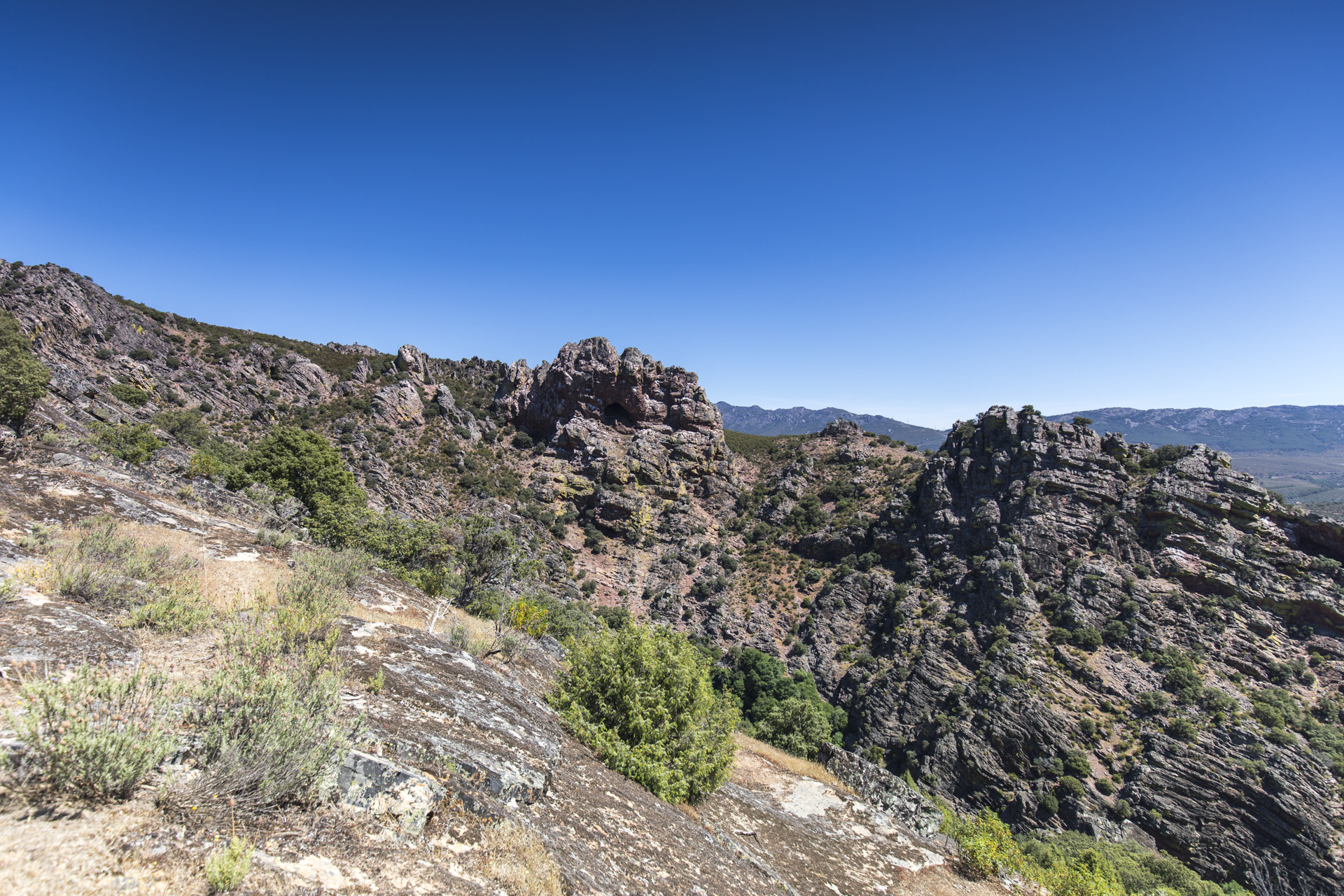
The Jarigüela stream cuts through the hard quartzitic rocks on the western flank of the Guadarranque-Gualija Syncline, forming the “Estrecho de la Peña Amarilla” (Yellow Rock Gorge)—so named for the abundance of yellowish lichens (*Acarospora oxitona*) that grow directly upon the rocks.
This river gorge is one of the most spectacular landscapes within the Geopark. Its rock walls, dating back to the Early to Middle Ordovician (over 470 million years ago), have been shaped by significant tectonic movements; the rocks—known as Armorican quartzites—exhibit numerous joints (fractures where the adjacent rock blocks have not shifted).
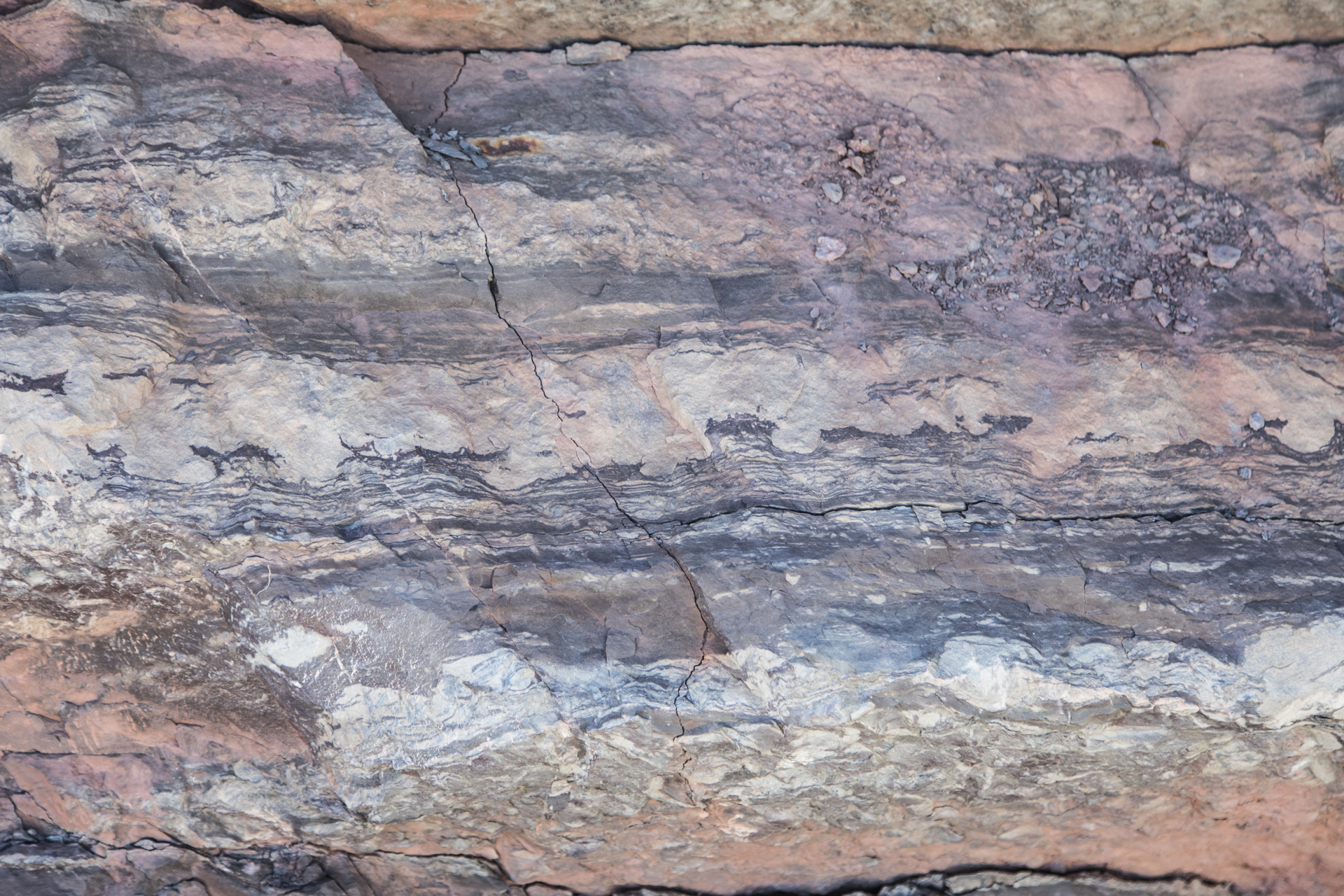
The site’s geological uniqueness is highlighted by an angular unconformity between the Ediacaran–Early Cambrian strata and those of the Ordovician. These two sequences are separated by a period of emergence—marked by continental deposits—followed by a marine transgression. Near the viewpoint, one can find excellent examples of *Cruziana*—trace fossils left by the movement or crawling of marine trilobites, an entirely extinct group. Some *Cruziana* specimens can even be seen in the road cuts, where they appear as striking cross-sections.