LOCATION AND ACCESS
You enter the village of Villar del Pedroso via the Puente del Arzobispo bridge, take a path on the right, immediately after passing the bridge over the Tagus (Tajo) river, and following the path closest to it, you will finally reach the gorge, in a distance of approximately two kilometres.
The gorge is about 750 m. long, from its beginning at an old mill to its mouth at the Tagus.
ATTRACTIONS OF THE VISIT
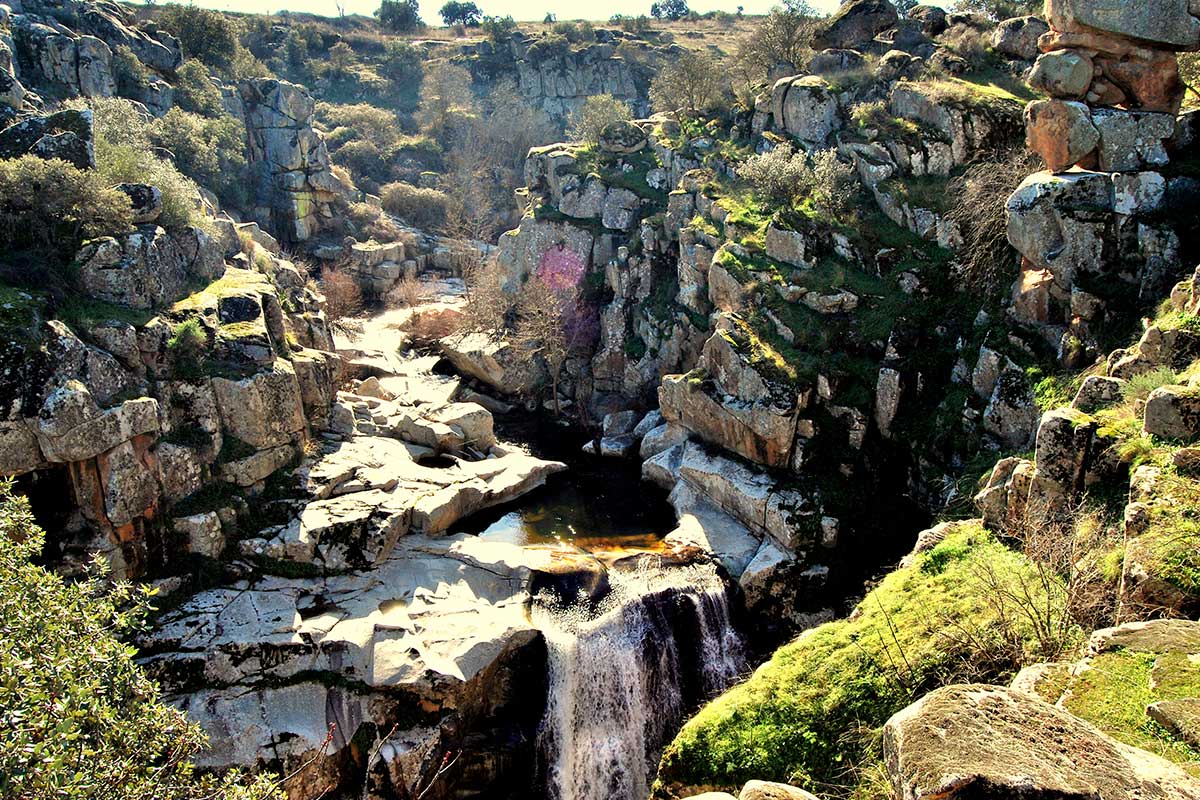
We will observe the curious erosive forms of the berrocal (a type of blocky terrain), caused by chemical and mechanical weathering of the granite rocks: the rounded blocks, the “mushroom stones” and the “horse stones”, as well as the different fracture planes (joints) that have determined the formation of blocks of different sizes within the massive granite rocks and in the aplite dykes.
It is spectacular to see how the Arroyo del Pedroso (Pedroso stream) flows into these rocks, with the formation of rapids, waterfalls and “marmitas de gigante” (giant’s kettles) or “pilancones” (see Geosite 32).
Nearby we can visit the ruins of several old mills and the impressive Fuerte de Castros (Fort of Castros), its walls, the pillars of the bridge over the Tagus river and the surrounding houses. This is a Muslim fortress built in the 10th century, next to the nearby Islamic city of Vascos, to defend the middle border of the Tagus.
In a square in Villar del Pedroso we can also admire several zoomorphic sculptures (“verracos”), made by the Vetón people in the Iron Age, as well as numerous Roman inscriptions of great archaeological interest.
GEOLOGICAL INTERPRETATION