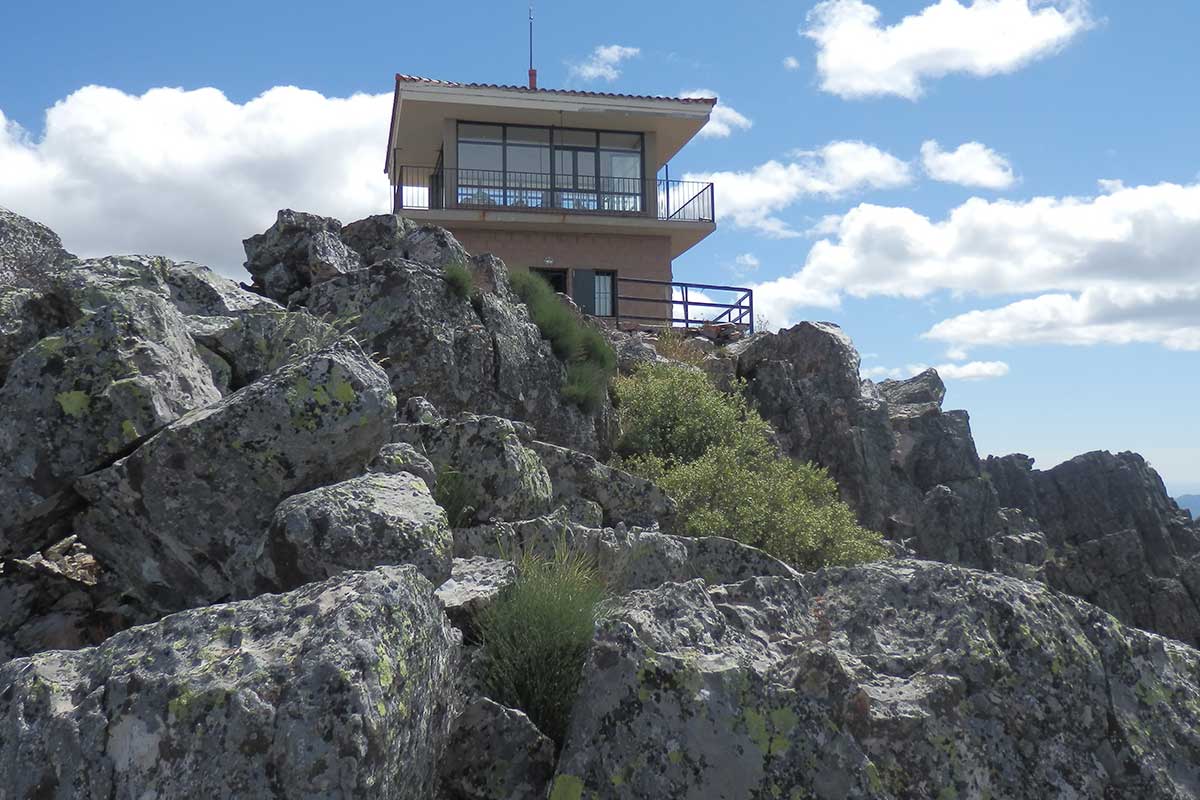
Like the other high viewpoints in the Geopark (La Villuerca and Risco Gordo), the Risco Carbonero is a rocky ridge of Armorican quartzite typical of the Lower Ordovician beach sedimentary deposits. The whole ascent is covered with boulders, or “hillside debris”, although the materials of the Ediacaran-Lower Cambrian Ibor Group and a very well exposed section of the Armorican Quartzite can also be seen in considerable detail, practically from its basal levels.
Risco Carbonero is an important palaeontological site of marine ichnofossils from the Ordovician period, Daedalus, Skolithos and Cruziana. Of particular importance are the Daedalus deposits, both in situ and in the blocks detached from the rocks.
The geological value of the Risco Carbonero is the interpretation of a large part of the Geopark. Due to its position and its great height, it provides a view of the Ibor-Guadalupe anticline to the west and the Guadarranque syncline to the east.
From here you can understand the geomorphology of the so-called “Appalachian relief” that defines the whole territory by observing the detail of the parallel sierras and valleys. The Armorican quartzite strata that form the Risco Carbonero, with an age of approximately 480 million years, are the most modern materials in this great folding structure.
In the valley we can see a group of shales, sandstones and conglomerates from the Ediacaran (ca. 545 Ma), among which we can find some calcareous and magnesian strata (dolomites) characteristic of this formation, known as the Ibor Group. On the other hand, if we look at the Guadarranque syncline, towards the east, we find a succession of Palaeozoic materials that are preserved until the Late Silurian (420 Ma.) in which shales, sandstones and quartzites from different stages of sedimentation alternate.