Geoparque Mundial UNESCO

Nº27 – Castañar Cave

Geoparque Villuercas > Nº27 – Castañar Cave

LOCATION AND ACCESS

The cave is located on the road from Castañar de Ibor to the campsite and passes by the Castañar Cave Interpretation Centre. To access the cave, take a path that leaves the road, very close to the Interpretation Centre.

The Castañar Cave, declared a Natural Monument of Extremadura, is an extremely fragile environment and can only be visited under a strict visiting regime. To access the guided visit to the interior of the cave it is necessary to register on a list according to the procedure established by the General Directorate of the Environment. The visiting period is from May 1st to September 30th.

Applications for visits will be accepted from 1 April.

As an alternative, it is very interesting to visit the Interpretation Centre. This centre has reproductions of the most characteristic speleothems, a virtual visit to the cave by means of a 3D projection and interpretation panels of all the geological elements of the cave and its surroundings.


The views set period of May 1 to September 30, 2015.
Requests for visits for 2015 will be accepted from April 1, 2015.

Application for entry into the Cave of Castañar
GUEST LIST
You must be registerd in a Guest reserve list. Access here to the information:

ATTRACTIONS OF THE VISIT

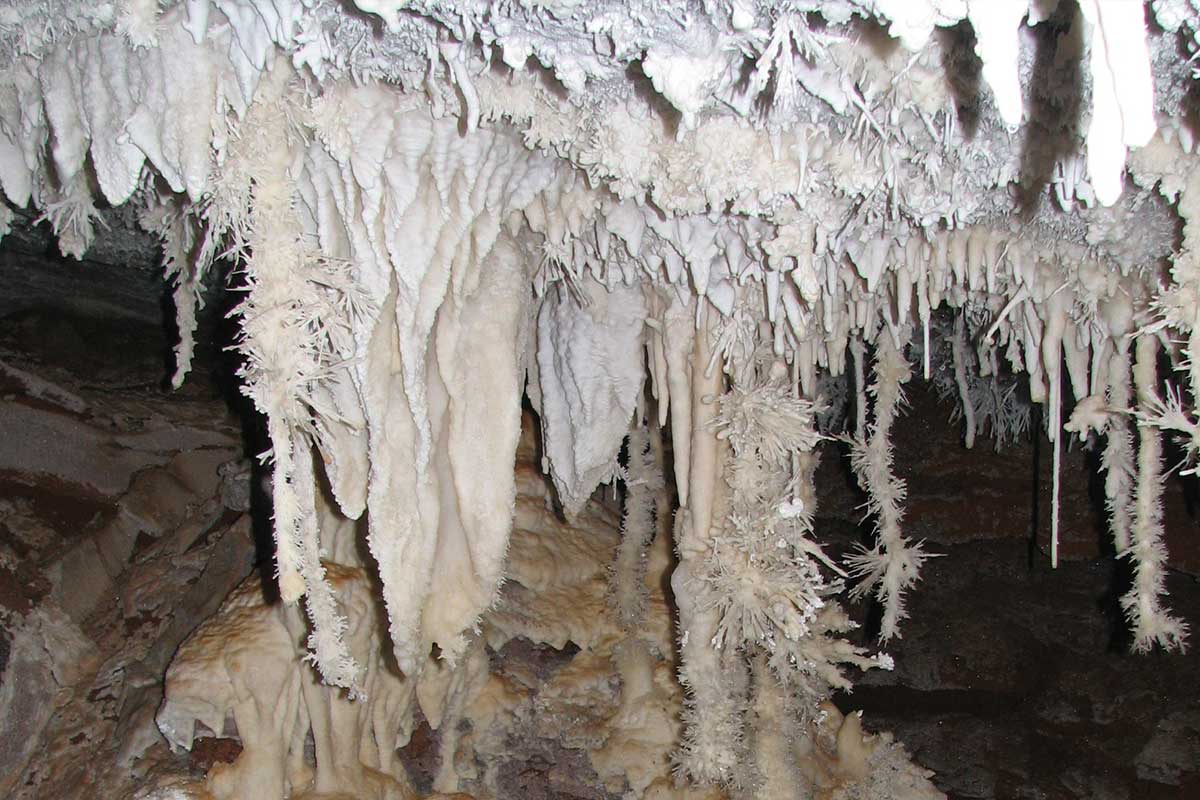
The cave is a cavity with an impressive and very fragile universe of speleothems (formations or structures that can be found inside a cave such as stalactites or stalagmites), with extremely fine and delicate shapes of great beauty, and light colours that contrast with the reddish and dark tones of the slate and clay that surround them, making the beauty of the karst formations stand out even more. The fragility of the formations and the risk of their alteration and destruction by indiscriminate visits led to their declaration as a protected natural area in 1997 as a Natural Monument.

The great variety of speleothems and their mineralogy (aragonite, dolomite, huntite, magnesite, hydromagnesite and sepiolite) is what makes the Castañar cave a unique karst cavity in the world. Both in the visit to the cave and in the Interpretation Centre you can appreciate this variety of speleothems that we describe below:

– Tailings: these are formations, generally of calcite, with large mantles that reach the ground in a staggered manner and were formed in areas where the flow of water was great.

– Flags or curtains: they are formed in areas where water flowed out through joints or small fractures, they hang from the walls like veils and are essentially of calcite.

– Rods: these are vertical forms with a tubular morphology that hang from the ceiling and have a central channel through which the water drips. They are made of aragonite or calcite.

– Stalactites: similar but larger than the rods. They are made of calcite or aragonite.

– Stalagmites: they grow from the ground, whenever there is a drip from a stalactite. Their composition is calcitic and/or aragonitic.

Columns: they are formed by the union of stalactites and stalagmites.

– Fibrous forms: these are the most characteristic speleothems in the Castañar cave. They are acicular crystals of aragonite, although locally they may have been transformed into calcite. They develop from a central point, forming very delicate fibrous-radial aggregates called “aragonite flowers”, which appear in the geopark logo.

– Moon-milk: this is a type of speleothem that usually develops on top of other previous speleothems, in their outermost zone. It is a dull white globular deposit that may have a high intercrystalline water content. The fundamental minerals that form it in this cave are dolomite and magnesite.

GEOLOGICAL INTERPRETATION

The cave developed within the carbonate rocks of the Ibor Group, in the upper levels of the Villarta Formation, whose age is late Ediacaran (approximately 541 million years ago), when the magnesian calcareous rocks (dolomites -CaMg(CO3)2– and magnesites -Mg(CO3)-) were dissolved, as well as by the subsequent collapse of the shales and sandstones that covered them.

On the other hand, the network of galleries in the cave follows the same orientation as the geological structure of the area, and the morphology of the different rooms reproduces to a certain extent the “box-like” shape of the folds that affect these rocks close to the Ediacaran-Cambrian transition. The fact that the cave develops in carbonate rocks very rich in magnesium means that the waters that circulate through the cave are also very rich in calcium and magnesium. This means that the speleothems or typical cave formations (stalactites, etc.) are calcareous mineral deposits such as calcite and aragonite. Magnesian minerals such as dolomite, magnesite, hydromagnesite and sepiolite also form part of the “moon-milk”.

The Castañar cave is a karstic cavity of small dimensions; it extends for some 2135 m² ,distributed in rooms and galleries that form a network of low cavities.

Once the entrance slope has been overcome, the main gallery is located, with a length of about 180 metres, where the first speleothems can be found. This corridor or gallery leads to different rooms called Sala Nevada (snowy room), Laberinto Este (eastern labyrinth), Sala del Jardín (garden room), Sala Blanca (white room)and Sala Final (final room), all of which are located in the eastern sector of the cave.

Among them, it is the Sala del Jardin that offers one of the most surprising spectacles to the visitor due to the beauty, variety and abundance of speleothems that cover the ceilings, walls and floor. From the Sala Nevada you can also access the western part of the cave, comprising the rooms of La Librería (the book store), Los Lagos (the lakes), Roja (red), Laberinto Norte (northern labyrinth), Las Planchas (the plates), Laberinto Sur (southern labyrinth) and Los Corales (the corals), in a circular route until you return to the Sala Nevada.